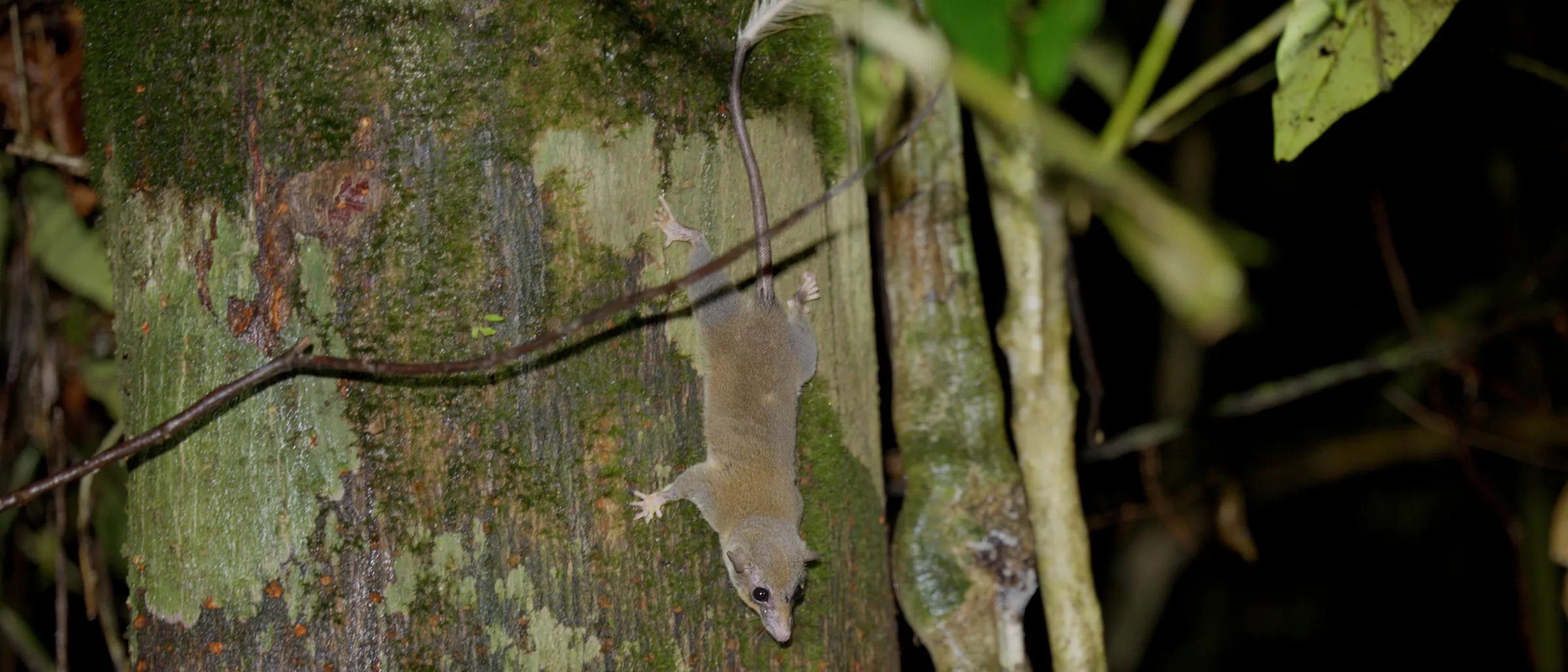
One of my first field notes, and a reminder of why the rainforest is such a rewarding place to work: no matter what you set out to document, there is always something around the next corner.
I came across this pen-tailed treeshrew in August 2025 while documenting a frog project in Borneo. The research team had finished their night surveys and we were walking back through the forest when we spotted it moving through the canopy. It came down the trunk of a tree right in front of us, paused, and then ran back up. Not a common animal to encounter, and I was glad to get a quick clip to document the moment. No one on the team had seen one before.
The pen-tailed treeshrew (Ptilocercus lowii) is a small, nocturnal, tree-living mammal found across southern Thailand, the Malay Peninsula, Sumatra, Borneo and a scatter of nearby islands. It is the sole living member of its family, Ptilocercidae, set apart from all other treeshrews, and is best recognised by the long, naked tail tipped with a feather-like fringe that gives the species its name. Treeshrews are of particular interest to scientists as close relatives of primates. This one is also famous for an unusual habit: in a Malaysian study, pen-tailed treeshrews were recorded feeding for hours each night on the naturally fermented nectar of the bertam palm, one of the most alcoholic foods known in nature, apparently without ill effect.
It is currently listed as Least Concern by the IUCN, though like so much rainforest wildlife its fortunes are tied to the fate of the forest itself.